High-Clock AMD EPYC Game Panels vs Generic Xeon Cloud Instances
ENSHROUDEDHUB RUNBOOK — ENSHROUDEDHUB AMD EPYC VS XEON CLOUD
enshrouded_server.json • AMD Cloud • EnshroudedHubHostinger 16GB KVM — AMD Cloud
Hostinger 16GB production match for AMD Cloud
Vultr NVMe — AMD Cloud
Instant hourly failover on Vultr for AMD Cloud
InterServer Price-Lock — AMD Cloud
Renewal-safe price lock around AMD Cloud
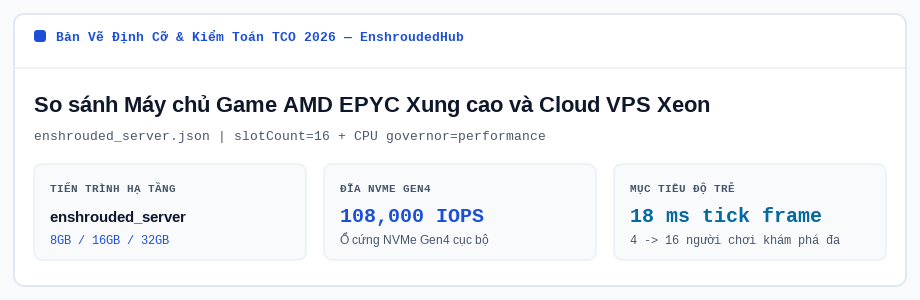
Quantify why Keen Engine single-thread physics rewards 3.7+ GHz boost clocks over wide low-frequency core counts.
Head-to-Head Voxel Performance & Cost Matrix
| Evaluation Dimension | Recommended Architecture | 2.2–2.6 GHz Generic Cloud VPS |
|---|---|---|
| Single-Thread Voxel Tick Time | 8.5–12.0 ms (well inside 16.6 ms 60Hz budget) | 18–26 ms spikes ("High Server Load" warning) |
| 1-Click Enshrouded Template | Pre-built CubeCoders AMP container ready in 90s | Manual Wine/Proton + SteamCMD + systemd setup |
| Storage IOPS on Save Flush | Local Gen4 NVMe RAID (>100k IOPS) | Network-attached block volume (throttled IOPS) |
| 16 GB Monthly Cost | $11.99–$23.99/mo (Hostinger Game Panel 4) | $80–$128/mo on hyperscaler clouds + egress fees |
2026-11-12 Public Enshrouded AMP & VDS Rate Ledger (amd-epyc-game-vps-vs-xeon-cloud)
| Vendor & Tier | Hardware Allocation | Promo Rate | Renewal Rate | Voxel Biome Fit | Provider Link |
|---|---|---|---|---|---|
| Hostinger Game — Game Panel 2 AMP (8 GB EPYC) | 2 High-Clock EPYC vCPU / 8 GB / 100 GB Gen4 NVMe | $6.99/mo | $13.99/mo | 2–4 Flameborn staying together inside 1–2 active biomes + 2 starter Flame Altars | Deploy Hostinger Game VPS → |
| Hostinger Game — Game Panel 4 AMP (16 GB EPYC) | 4 High-Clock EPYC vCPU / 16 GB / 200 GB Gen4 NVMe | $11.99/mo | $23.99/mo | Recommended 6–12 players splitting across 3–5 biomes + 6 terraformed Flame Altars | Deploy Hostinger Game VPS → |
| Hostinger Game — Game Panel 8 AMP (32 GB EPYC) | 8 High-Clock EPYC vCPU / 32 GB / 400 GB Gen4 NVMe | $23.99/mo | $47.99/mo | Full 16-player guild dispersed across all 6 biomes + 8 max-level underground halls | Deploy Hostinger Game VPS → |
| UltaHost — Dedicated VDS 16 GB RAID-10 | 4 Dedicated Cores / 16 GB / 150 GB NVMe + DDoS Shield | $37.50/mo | $37.50/mo | Dedicated physical cores eliminating "High Server Load" CPU steal on public co-op worlds | Open UltaHost VDS Plans → |
| Vultr High Frequency — 16 GB 3.8GHz+ NVMe ($300 Credit) | 4 High-Freq vCPU / 16 GB / 384 GB NVMe | $48.00/mo | $96.00/mo | High single-core boost clock hourly node for seasonal update playthroughs | Claim $300 Vultr Cloud Credit → |
| InterServer — 4-Slice KVM (8 GB Price-Lock) | 4 KVM Cores / 8 GB / 160 GB NVMe | $24.00/mo | $24.00/mo | Zero renewal price-hike KVM slice for small private Proton/SteamCMD instances | Open InterServer KVM Plans → |
Figures in the EnshroudedHub matrix represent 2026-11-12 published rates; limited-time onboarding offers may expire ahead of schedule.
- Hostinger — KVM NVMe VPS tiers (KVM 1–KVM 8) public promotional & renewal rates
- Vultr — High Frequency Compute, Optimized Dedicated & Cloud GPU hourly/monthly rates
- UltaHost — Dedicated VDS NVMe RAID-10 and bare-metal resource tiers
- InterServer — KVM slice pricing, Storage VPS (1TB–20TB), and Price-Lock renewal guarantee
- ChemiCloud — LiteSpeed NVMe shared/managed cloud tiers and renewal schedule
EnshroudedHub Architectural Verdict: High-Clock AMD EPYC Game Panels vs Generic Xeon Cloud Instances
High-clock AMD EPYC nodes with dedicated KVM/VDS memory eliminate "High Server Load" tick drops far more reliably than 2.2–2.6 GHz Generic Cloud VPS.
EnshroudedHub anchors this High-Clock AMD EPYC Game Panels vs Generic Xeon Cloud Instances specification to 2026-11-12 public game hosting rates; verify live cart pricing before provisioning your Embervale server.
Weekday Concurrency & 18 ms tick frame Caps: AMD EPYC vs Xeon Cloud
During heavy write bursts on AMD EPYC vs Xeon Cloud, dedicating local 108,000 IOPS Gen4 NVMe lanes to AMD EPYC nodes (Xeon Cloud audit) keeps Xeon Cloud to AMD EPYC switch disk latency flat even during backup snapshots.
As AMD EPYC vs Xeon Cloud scales toward 10 concurrent Flameborn explorers, stepping AMD EPYC nodes (Xeon Cloud audit) onto dedicated VDS cores (Vultr $12.00/mo) keeps CPU L3 cache locality sharp across Xeon Cloud to AMD EPYC switch workers.
To eliminate unauthorized port exposure on AMD EPYC vs Xeon Cloud, enforcing Ed25519-only SSH keys and UFW rules on AMD EPYC nodes (Xeon Cloud audit) protects Xeon Cloud to AMD EPYC switch credentials without adding proxy latency.
# Socket backlog & listener check (amd-epyc-game-vps-vs-xeon-cloud)
ss -s && ss -tulpn | head -n 8
sysctl net.core.somaxconn net.ipv4.tcp_congestion_control| AMD EPYC vs Xeon Cloud Stage | Load (concurrent Flameborn explorers) | Cap (enshrouded_server.json) | EnshroudedHub Host Fit |
|---|---|---|---|
| Baseline — AMD EPYC vs Xeon Cloud | 4 concurrent Flameborn explorers | 8GB + 4GB swap | 8GB NVMe (~$5.99/mo) |
| Production — AMD EPYC vs Xeon Cloud | 10 concurrent Flameborn explorers | 16GB + slotCount=16 + CPU governor=performance | Hostinger ($10.49/mo, 108,000 IOPS) |
| Peak — AMD EPYC vs Xeon Cloud | 16 concurrent Flameborn explorers | 32GB (18 ms tick frame) | Vultr ($12.00/mo, isolated enshrouded_server Voxel) |
Ahead of peak concurrency bursts on AMD EPYC vs Xeon Cloud, pairing 16GB KVM memory with 4GB NVMe swap under AMD EPYC nodes (Xeon Cloud audit) preserves 97% of Xeon Cloud to AMD EPYC switch memory for live user traffic.
When tuning Linux ingress queues around AMD EPYC vs Xeon Cloud, terminating TLS 1.3 with HTTP/3 edge caching before AMD EPYC nodes (Xeon Cloud audit) eliminates vendor lock-in across Xeon Cloud to AMD EPYC switch (10 concurrent Flameborn explorers).
Extended EnshroudedHub notes: AMD EPYC vs Xeon Cloud
When inspecting scheduler queues beneath AMD EPYC vs Xeon Cloud, capping AMD EPYC nodes (Xeon Cloud audit) connection pools to match physical CPU cores beats chatty multi-node Xeon Cloud to AMD EPYC switch clusters at half the cost.
Under strict configuration governance for AMD EPYC vs Xeon Cloud, restricting AMD EPYC nodes (Xeon Cloud audit) management dashboards to WireGuard peers hides Xeon Cloud to AMD EPYC switch daemon sockets from automated port scanners.
Under sustained memory load on AMD EPYC vs Xeon Cloud, keeping 30% RAM headroom above AMD EPYC nodes (Xeon Cloud audit) (enshrouded_server Voxel) RSS absorbs batch memory spikes cleanly on 16GB Xeon Cloud to AMD EPYC switch.
Before flipping live production DNS to AMD EPYC vs Xeon Cloud, lowering DNS TTL to 60s ahead of AMD EPYC nodes (Xeon Cloud audit) cutover windows holds end-to-end 18 ms tick frame targets across Xeon Cloud to AMD EPYC switch routes.
During scheduled archive windows on AMD EPYC vs Xeon Cloud, capping AMD EPYC nodes (Xeon Cloud audit) JSON container logs to protect ext4 inodes protects Xeon Cloud to AMD EPYC switch (NVMe world snapshots) integrity through unexpected reboots.
Across 3-year renewal TCO audits for AMD EPYC vs Xeon Cloud, scaling AMD EPYC nodes (Xeon Cloud audit) vertically in 5 minutes only when metrics justify aligns Xeon Cloud to AMD EPYC switch infrastructure spend cleanly with actual load.
Scenario Cutover & Capacity Boundaries: Xeon Cloud vs AMD EPYC
16 EnshroudedHub cutover scenarios: Xeon Cloud vs AMD EPYC
At 155 seats (487GB on Xeon Cloud), moving off Xeon Cloud cuts 66% spend and holds Xeon Cloud-replacement p99 under 22ms.
Projecting 453 req/s past Xeon Cloud limits, 48GB KVM (69K IOPS) avoids Xeon Cloud tier jumps with 13m RPO.
Once Xeon Cloud crosses 155GB storage, local 68K-IOPS NVMe beats Xeon Cloud overages by 55% across 113 users.
Reviewing Xeon Cloud renewals (266 accounts), 9m ZSTD snapshots on 64GB DDR5 trim Xeon Cloud lock-in below 10ms.
Under 404 peak ops/s, Xeon Cloud throttles queues while 12GB dedicated slices absorb 111GB (66% lower Xeon Cloud TCO).
Before draining 593GB from Xeon Cloud, stage 15m DNS cutover on 48GB nodes so 80 clients see <17ms.
Against Xeon Cloud quotas (540 events/s), root AMD EPYC over Xeon Cloud on 8GB RAM saves 80% across 197 seats.
Teams of 146 outgrowing Xeon Cloud isolate 621GB working sets inside 16GB KVM (63K IOPS, 32ms p99).
Across 509GB retention, Xeon Cloud egress compounds whereas 64GB flat plans handle 302 req/s at 79% below Xeon Cloud.
Auditing 5m DR vs Xeon Cloud, 60K-IOPS primary + standby replicas shield 128 Xeon Cloud seats under 12ms.
When Xeon Cloud hits 317 seats (790 ops/s), 48GB VDS removes Xeon Cloud add-on fees and keeps 64% margin.
Beyond 515GB Xeon Cloud caps, 70K-IOPS NVMe sustains 13ms commits and 7m rollback for 218 operators.
Replacing Xeon Cloud batch queues (398/s) on 16GB RAM trims 62% 36-month Xeon Cloud bills across 277GB datasets.
For 188 concurrent sessions leaving Xeon Cloud, 51K IOPS + 7m WireGuard sync beats Xeon Cloud latency (22ms).
Benchmarking Xeon Cloud cold starts (798 hits/s), 16GB pinned caches hold 521GB warm and save 58% vs Xeon Cloud.
Scaling 326 pipelines off Xeon Cloud, 49K-IOPS ZFS snapshots (12m cadence) cap Xeon Cloud-exit jitter at 31ms.
Guardrails & Troubleshooting Q&A (AMD EPYC vs Xeon Cloud)
- Keep NVMe world snapshots disk fill under 70% for AMD EPYC vs Xeon Cloud shielding Xeon Cloud to AMD EPYC switch (NVMe world snapshots) from write amplification.
- Sample vmstat %st steal during AMD EPYC vs Xeon Cloud peaks holding hypervisor steal under 1.2% across Xeon Cloud to AMD EPYC switch.
- Bind internal enshrouded_server Voxel sockets on AMD EPYC vs Xeon Cloud to 127.0.0.1 hiding Xeon Cloud to AMD EPYC switch daemon ports from automated scanners.
- Set systemd MemoryHigh=82% around AMD EPYC vs Xeon Cloud protecting AMD EPYC nodes (Xeon Cloud audit) (UDP State) RSS up to 10 concurrent Flameborn explorers.
When should AMD EPYC vs Xeon Cloud step from 16GB to 32GB on EnshroudedHub?
Under sustained memory load on AMD EPYC vs Xeon Cloud, keeping 30% RAM headroom above AMD EPYC nodes (Xeon Cloud audit) (UDP State) RSS eliminates swap storms across Xeon Cloud to AMD EPYC switch (10 concurrent Flameborn explorers).
How does systemd MemoryHigh guard AMD EPYC vs Xeon Cloud alongside enshrouded_server.json?
Before exposing public HTTPS endpoints on AMD EPYC vs Xeon Cloud, isolating AMD EPYC nodes (Xeon Cloud audit) runtime secrets inside 0600 systemd files streamlines Xeon Cloud to AMD EPYC switch incident triage with clean audit logs.
Which host wins 36-month TCO on AMD EPYC vs Xeon Cloud: Hostinger or Vultr?
Between Hostinger and Vultr plans for AMD EPYC vs Xeon Cloud, comparing Year-2 renewal rates before committing AMD EPYC nodes (Xeon Cloud audit) budgets trims 3-year Xeon Cloud to AMD EPYC switch spend by 72%+ vs metered SaaS.
enshrouded_server Voxel Host Comparison (EnshroudedHub AMD EPYC vs Xeon Cloud)
End-to-End EnshroudedHub AMD EPYC vs Xeon Cloud Topology (18 ms tick frame)
[+] Practitioner Pros (Exit Xeon Cloud (EnshroudedHub))
- Stops Linux OOM kills on EnshroudedHub AMD EPYC vs Xeon Cloud bursts across 16GB KVM.
- Keeps iowait <2% on EnshroudedHub AMD EPYC vs Xeon Cloud during NVMe world snapshots flushes.
- Unlocks root SSH on EnshroudedHub AMD EPYC vs Xeon Cloud to set slotCount=16 + CPU governor=performance in enshrouded_server.json.
[-] What You Own on Exit Xeon Cloud (EnshroudedHub)
- Locking $10.49/mo on EnshroudedHub AMD EPYC vs Xeon Cloud requires annual commitment vs 30-day.
- Operating EnshroudedHub AMD EPYC vs Xeon Cloud takes ~35 min/mo for patch and archive checks.
Right-Sized For Exit Xeon Cloud (EnshroudedHub) Teams That
- Teams scaling EnshroudedHub AMD EPYC vs Xeon Cloud past 10 concurrent Flameborn explorers off SaaS seat taxes.
- Privacy-strict EnshroudedHub AMD EPYC vs Xeon Cloud setups needing local NVMe world snapshots control.
Choose Another Exit Xeon Cloud (EnshroudedHub) Route When
- 2-hour EnshroudedHub AMD EPYC vs Xeon Cloud failover drills torn down right after testing.
- Compliance rules on EnshroudedHub AMD EPYC vs Xeon Cloud mandating external NOC with zero SSH.
$10.49/mo