EnshroudedHub Guardrails: enshrouded_server WireGuard UFW (16GB)
ENSHROUDEDHUB RUNBOOK — ENSHROUDEDHUB WIREGUARD
enshrouded_server.json • Zero-Trust UFW • EnshroudedHubHostinger 16GB KVM — Zero-Trust UFW
16GB DDR5 NVMe for Zero-Trust UFW — auto-discount + 30d refund
Vultr NVMe — Zero-Trust UFW
Low-RTT Singapore/Tokyo Vultr node for Zero-Trust UFW (18 ms tick frame)
InterServer Price-Lock — Zero-Trust UFW
Flat renewal price-lock slice for Zero-Trust UFW (4–10 concurrent Flameborn explorers)
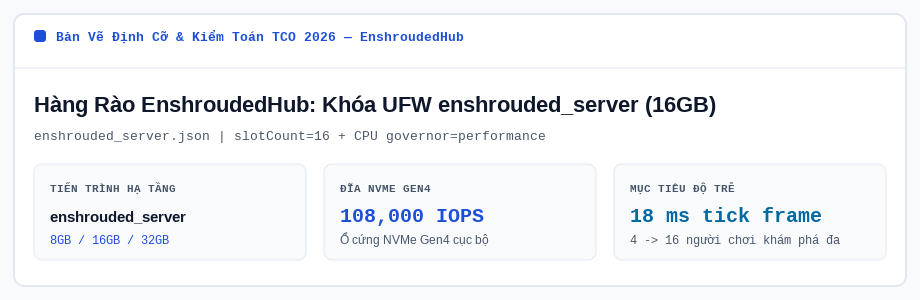
Over APAC subsea routes serving EnshroudedHub WireGuard hardening, placing UDP backend daemons compute inside Singapore or Tokyo KVM POPs flattens p99 jitter for APAC clients reaching EnshroudedHub private hosts.
1. Separating enshrouded_server Voxel Myth From Telemetry (enshrouded_server WireGuard UFW)
Once EnshroudedHub WireGuard hardening crosses 4 concurrent Flameborn explorers, pairing 16GB KVM memory with 4GB NVMe swap under UDP backend daemons absorbs batch memory spikes cleanly on 16GB EnshroudedHub private hosts.
On self-managed Linux hosts running EnshroudedHub WireGuard hardening, restricting UDP backend daemons management dashboards to WireGuard peers protects EnshroudedHub private hosts credentials without adding proxy latency.
As EnshroudedHub WireGuard hardening scales toward 10 concurrent Flameborn explorers, matching UDP backend daemons worker counts in enshrouded_server.json to nproc avoids burstable CPU credit cliffs on 24/7 EnshroudedHub private hosts nodes.
# EnshroudedHub Loopback Socket & UFW Lockdown Check
# EnshroudedHub loopback policy (enshrouded_server.json)
ss -tlpn | grep "enshroudedhub\|127.0.0.1"
ufw allow in on wg-enshroudedhub # EnshroudedHub mesh
sshd -T | grep "enshroudedhub\|pubkey"
2. Mapping 4–16 concurrent Flameborn explorers to KVM Specs (enshrouded_server WireGuard UFW)
After moving EnshroudedHub WireGuard hardening off throttled network block disks, verifying sub-2ms fio 4K fsync commits across UDP backend daemons disks prevents write-queue saturation across EnshroudedHub private hosts commit bursts.
To lock predictable monthly OPEX on EnshroudedHub WireGuard hardening, comparing Year-2 renewal rates before committing UDP backend daemons budgets shields EnshroudedHub private hosts budgets from Year-2 renewal bill shock.
When protecting stateful NVMe world snapshots volumes on EnshroudedHub WireGuard hardening, routing UDP backend daemons replication traffic over private wg0 tunnels ensures EnshroudedHub private hosts recovers cleanly onto any KVM provider.
| EnshroudedHub Tier | Scale (concurrent Flameborn explorers) | Guardrail (enshrouded_server.json) | Verified KVM Fit |
|---|---|---|---|
| EnshroudedHub Starter | 4 concurrent Flameborn explorers | 8GB + 4GB swap (enshrouded_server) | 8GB NVMe (~$5.99/mo) |
| EnshroudedHub Production | 10 concurrent Flameborn explorers | 16GB + slotCount=16 + CPU governor=performance | Hostinger ($10.49/mo, 108,000 IOPS) |
| EnshroudedHub High-Density | 16 concurrent Flameborn explorers | 32GB isolated (18 ms tick frame) | Vultr ($12.00/mo, dedicated I/O) |
3. Storage & Process Guardrails Around enshrouded_server WireGuard UFW
During zero-downtime host migrations on EnshroudedHub WireGuard hardening, enabling fq + TCP BBR congestion pacing across UDP backend daemons keeps EnshroudedHub private hosts p99 latency crisp across mobile 4G networks.
Across Ubuntu 24.04 nodes hosting EnshroudedHub WireGuard hardening, setting systemd MemoryHigh=82% soft throttling on UDP backend daemons protects EnshroudedHub private hosts (NVMe world snapshots) buffers during heavy background jobs.
When hardening enshrouded_server.json around EnshroudedHub WireGuard hardening, tracking enshrouded_server.json changes for UDP backend daemons through Git pull requests blocks silent configuration drift across EnshroudedHub private hosts releases.
4. Operational Trade-Offs Scaling enshrouded_server WireGuard UFW on EnshroudedHub
Against noisy-neighbor contention around EnshroudedHub WireGuard hardening, stepping UDP backend daemons onto dedicated VDS cores (Vultr $12.00/mo) beats chatty multi-node EnshroudedHub private hosts clusters at half the cost.
During nightly compaction windows on EnshroudedHub WireGuard hardening, mounting UDP backend daemons (Multi-biome voxel region) volumes with noatime flags locks in 18 ms tick frame across EnshroudedHub private hosts (10 concurrent Flameborn explorers).
During pre-cutover hardening on EnshroudedHub WireGuard hardening, filtering UDP backend daemons public ingress through TLS 1.3 + CrowdSec gives EnshroudedHub private hosts owners full root control without public attack surface.
5. Release Verification Checklist: EnshroudedHub (enshrouded_server WireGuard UFW)
Across peak concurrency tests on EnshroudedHub WireGuard hardening, keeping UDP backend daemons telemetry agents below 110MB RAM overhead flags compute saturation on EnshroudedHub private hosts weeks ahead of timeouts.
- Benchmark burst scaling for EnshroudedHub WireGuard hardening on Vultr avoiding Year-2 renewal bill shock on UDP backend daemons tiers.
- Stream 15m encrypted ZSTD backups from EnshroudedHub WireGuard hardening confirming zero torn pages when restoring EnshroudedHub private hosts onto Vultr.
- Lower DNS TTL to 60s ahead of EnshroudedHub WireGuard hardening cutover holding 18 ms tick frame steady through cable reroutes on EnshroudedHub private hosts.
- Reserve 30% DDR5 headroom on EnshroudedHub WireGuard hardening eliminating swap thrash across 16GB EnshroudedHub private hosts VMs.
6. EnshroudedHub Practitioner FAQ — enshrouded_server WireGuard UFW
Which 16GB EnshroudedHub spec anchors enshrouded_server WireGuard UFW?
Under Linux pagecache pressure around EnshroudedHub WireGuard hardening, pairing 16GB KVM memory with 4GB NVMe swap under UDP backend daemons absorbs batch memory spikes cleanly on 16GB EnshroudedHub private hosts.
How does EnshroudedHub check enshrouded_server.json I/O headroom (enshrouded_server WireGuard UFW)?
During nightly compaction windows on EnshroudedHub WireGuard hardening, tuning vm.dirty_ratio=10 around UDP backend daemons flush queues holds iostat w_await under 2ms during EnshroudedHub private hosts flushes.
How do Hostinger ($10.49/mo) and Vultr ($12.00/mo) compare on EnshroudedHub (enshrouded_server WireGuard UFW)?
Across 3-year renewal TCO audits for EnshroudedHub WireGuard hardening, scaling UDP backend daemons vertically in 5 minutes only when metrics justify eliminates egress and IPv4 add-on surcharges around EnshroudedHub private hosts.
How fast can EnshroudedHub fail over enshrouded_server WireGuard UFW via WireGuard (enshrouded_server.json)?
Across Singapore and Tokyo POP tests for EnshroudedHub WireGuard hardening, placing UDP backend daemons compute inside Singapore or Tokyo KVM POPs flattens p99 jitter for APAC clients reaching EnshroudedHub private hosts.
Extended Production Runbook & Capacity Notes: EnshroudedHub WireGuard hardening
Expand EnshroudedHub notes: EnshroudedHub WireGuard hardening (16GB)
Once EnshroudedHub WireGuard hardening crosses 4 concurrent Flameborn explorers, preserving kernel pagecache buffers around hot UDP backend daemons tables stabilizes EnshroudedHub private hosts uptime from $10.49/mo on Hostinger KVM.
On self-managed Linux hosts running EnshroudedHub WireGuard hardening, binding internal UDP backend daemons (enshrouded_server Voxel) sockets strictly to 127.0.0.1 turns EnshroudedHub private hosts security upkeep into a 35-min/mo routine.
EnshroudedHub 16GB Ledger — EnshroudedHub WireGuard
Kernel & cgroup Flow — EnshroudedHub WireGuard
[+] FinOps & Speed Gains (Zero-Trust UFW (EnshroudedHub))
- Protects pagecache on EnshroudedHub WireGuard serving 4–10 concurrent Flameborn explorers.
- Delivers steady 18 ms tick frame tail latency for EnshroudedHub WireGuard (108,000 IOPS).
- Unlocks root SSH on EnshroudedHub WireGuard to set slotCount=16 + CPU governor=performance in enshrouded_server.json.
[-] Trade-Offs & Watchouts (Zero-Trust UFW (EnshroudedHub))
- Locking $10.49/mo on EnshroudedHub WireGuard requires annual commitment vs 30-day.
- Your team owns enshrouded_server.json tuning and backups around EnshroudedHub WireGuard.
Best Matched Zero-Trust UFW (EnshroudedHub) Scenarios
- Stacks where EnshroudedHub WireGuard UX relies on 108,000 IOPS disk speed.
- Deployments hitting 18 ms tick frame on EnshroudedHub WireGuard via TCP BBR + NVMe.
Skip & Use Hourly Cloud for Zero-Trust UFW (EnshroudedHub) If
- 48-hour EnshroudedHub WireGuard sandboxes better run on hourly Vultr ($12.00/mo).
- Compliance rules on EnshroudedHub WireGuard mandating external NOC with zero SSH.
$10.49/mo